
Overview #
Children’s biobanking is an essential resource for advancing paediatric biomedical research and improving the prevention, diagnosis, and treatment of diseases affecting infants, children, and adolescents.
Evidence generated from adult populations cannot simply be extrapolated to children, whose physiology, metabolism, immune responses, and developmental trajectories differ significantly from those of adults. Consequently, children should be regarded as a distinct research population and offered appropriate opportunities to participate in biobanking, with the ultimate aim of improving paediatric health outcomes.
At the same time, involving children in biobanking raises unique ethical, legal, and societal challenges. Childhood is characterised by continuous physical, cognitive, emotional, and social development. As a result, children are generally considered a vulnerable research population because they have limited legal capacity to provide informed consent and varying abilities to understand research participation and communicate their wishes. Their vulnerability, however, should not be understood solely as a justification for protection. Rather, it calls for governance frameworks that combine protection with the progressive recognition of children’s developing autonomy.
Biobanks therefore play a central role in safeguarding children’s rights while promoting their meaningful participation throughout the research process. This requires governance mechanisms that evolve alongside the child, adapting information, communication, and decision-making processes to the participant’s age and maturity. As children grow, they should increasingly be involved in decisions concerning the collection, storage, and future use of their biological samples and data, culminating, where appropriate, in re-consent once they reach the age of legal competence.
Paediatric biobanking also represents an important model for Responsible Research and Innovation (RRI). By encouraging dialogue among children, parents or guardians, researchers, clinicians, biobank professionals, and ethics committees, it promotes a participatory approach to research governance that strengthens scientific citizenship, public trust, and reciprocal engagement. Rather than viewing children solely as passive recipients of protection, contemporary paediatric biobanking increasingly recognises them as active participants whose perspectives should be heard and progressively integrated into research governance.
This evolving understanding reflects a broader paradigm shift in biomedical research. The emphasis has moved from a predominantly paternalistic model—where decisions were made exclusively by adults on behalf of children—to an inclusive and dynamic framework centred on empowerment, participation, and respect for children’s evolving capacities. Sustainable and ethically responsible paediatric biobanking therefore depends on the active engagement of all stakeholders, including children themselves, their families, researchers, biobank professionals, ethics committees, and policymakers.
Key ethical, legal and societal issues #
Biobanking and research with minors, namely children and young people, raises various ethical, legal and societal issues, which should be addressed. Key issues include:
Children as participants #
Children are recognised as a vulnerable population because of their evolving cognitive, emotional, and legal capacity. However, their vulnerability should not justify exclusion from biomedical research. Rather, it requires additional safeguards that protect their rights while progressively empowering them to participate in decisions affecting their biological samples and associated data. Ethical paediatric biobanking therefore seeks to balance protection with recognition of children’s developing autonomy.
Consent, assent and re-consent #
Because minors generally lack the legal capacity to provide informed consent, participation in biobanking requires the permission of parents or legal guardians. Nevertheless, children should not be regarded as passive participants. According to their age, maturity, and understanding, they should receive age-appropriate information and be actively involved in decision-making through assent processes. Their opinions and objections should be respected whenever possible.
As children mature, their role in decision-making should progressively increase. Once they reach the age of legal competence, reasonable efforts should be made to obtain their own informed consent (re-consent) for the continued storage and use of their biological samples and associated data. Re-consent reflects the dynamic nature of paediatric biobanking and reinforces respect for participants’ autonomy throughout the life course.
Privacy, confidentiality and data protection #
Paediatric biobanks collect highly sensitive personal information, including genetic, genomic, clinical, and health-related data that may remain valuable throughout an individual’s lifetime. Protecting children’s privacy therefore requires robust technical, organisational, and legal safeguards to ensure confidentiality, secure data management, controlled access, and responsible data sharing. Particular attention should be paid to the long-term implications of genomic information, which may also reveal information about biological relatives.
Benefit–risk assessment and the child’s best interests #
Although participation in biobanking generally involves minimal physical risk, ethical considerations extend well beyond sample collection. Long-term storage of biological materials, future unspecified research, incidental findings, and potential psychosocial consequences must all be carefully considered. Biobanks should ensure that foreseeable risks remain proportionate to the expected scientific and societal benefits, while always giving primary consideration to the best interests of the child.
Return of research results #
Research involving children’s biological materials may generate individual findings, including clinically significant or incidental genetic results. Biobanks should establish clear governance policies regarding whether, when, and under what circumstances such findings should be returned to participants or their parents or guardians. Decisions should take into account the child’s age, maturity, clinical relevance of the finding, future autonomy, and the availability of appropriate genetic counselling and clinical support.
Participation, engagement and scientific citizenship #
Modern paediatric biobanking increasingly promotes children and their families as active partners rather than passive research subjects. Continuous engagement throughout the research lifecycle strengthens trust, transparency, and accountability while fostering Responsible Research and Innovation (RRI). Age-appropriate communication, ongoing dialogue, and opportunities to review participation preferences contribute to scientific citizenship and encourage sustainable participation over time.
Governance and oversight #
Strong governance frameworks are essential to safeguard children’s rights throughout the entire biobanking lifecycle. Ethics committees, biobanks, researchers, healthcare professionals, and parents all share responsibility for ensuring that children’s interests remain central as they mature. Governance should include transparent consent procedures, regular ethical review, policies for re-consent, privacy protection, return of results, data sharing, and long-term oversight. Given that legal requirements vary across jurisdictions, governance frameworks should also ensure compliance with applicable national, European, and international regulations while promoting harmonised best practices.
Legal and ethical international and EU sources #
- EU Charter of Fundamental Rights, art. 24
- Regulation on medicinal products for paediatric use: Regulation (EC) No 1901/2006 of the European Parliament and of the Council of 12 December 2006 on medicinal products for paediatric use and amending Regulation (EEC) No 1768/92, Directive 2001/20/EC, Directive 2001/83/EC and Regulation (EC) No 726/2004 (Text with EEA relevance)
- Recommendation Rec (2006)4 of the Committee of Ministers of the Council of Europe to Member States on research on biological materials of human origin and its Explanatory Memorandum
- Recommendation CM/Rec(2016)6 of the Committee of Ministers of the Council of Europe to Member States on research on biological materials of human origin
- CIOMS, Guideline 17 – Research involving children and adolescents. The International Ethical Guidelines for Health-related Research Involving Humans Prepared by the Council for International Organizations of Medical Sciences (CIOMS) in collaboration with the World Health Organization (WHO)
- Belmont Report: Ethical Principles and Guidelines for the Protection of Human Subjects of Research, Report of the National Commission for the Protection of Human Subjects of Biomedical and Behavioral Research
Children as research participants: From protection to participation #
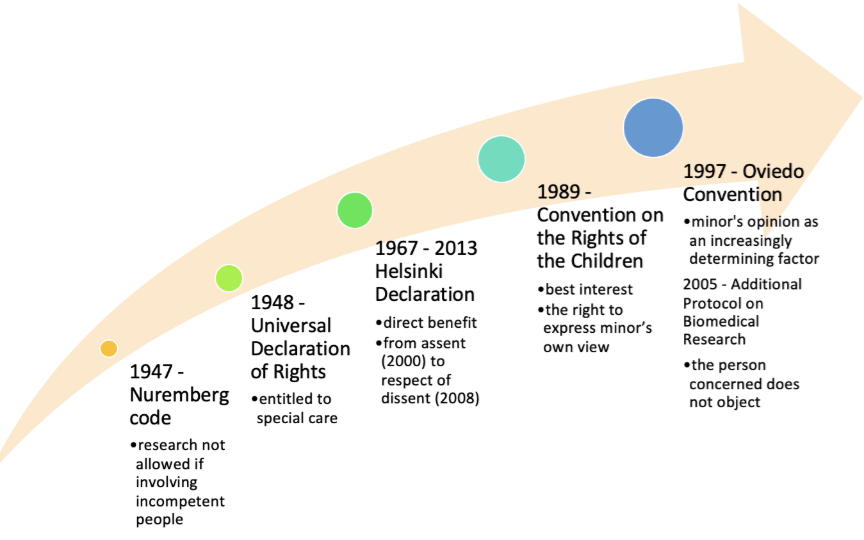
The ethical and legal framework governing paediatric biobanking has undergone a profound evolution over the past seventy years. Following the atrocities revealed after the Second World War, the Nuremberg Code established voluntary informed consent as the cornerstone of ethical research involving human participants. Although children were initially viewed primarily through the lens of protection, subsequent international instruments progressively recognised them as individuals with evolving capacities and corresponding rights to participate in decisions affecting them.
Children are by definition a vulnerable population, thus, according to Art. 25(2) of the Universal Declaration of Human Rights, they are “entitled to special care and assistance”. They are subjects in evolution, in need of protection, who often cannot participate or take control of the decisions affecting them.
The Belmont Report (1979) has introduced the principle of respect for persons, recognising that children require protection while simultaneously emphasising that they should be involved in research decisions to the extent that their maturity allows. Rather than treating incapacity as a permanent condition, the Report has acknowledged that autonomy develops over time and should be reassessed as children grow.
This participatory approach has been progressively reinforced through international and European legal instruments. Article 24 of the Charter of Fundamental Rights of the European Union recognises children’s right to express their views freely in matters affecting them, with due consideration given to their age and maturity.
It must be observed that the regulatory framework has revolved primarily around clinical trials and biomedical research in the strict sense. In fact, only in 2006 the Council of Europe published the first Recommendation on biobanking and research on biological material of human origin (Recommendation Rec (2006)4 of the Committee of Ministers to member states on research on biological materials of human origin and its Explanatory Memorandum, see art. 15). It has taken fifty years basically to deconstruct the paternalistic paradigm, to include the minor, to respect him/her by providing and encouraging processes and tools of self-determination, such as assent, dissent/disagreement and reconsent. Similarly, the Clinical Trials Regulation (EU) No 536/2014 distinguishes between parental authorisation and the child’s own participation in the consent process, requiring that minors receive age-appropriate information from professionals experienced in working with children (see art. 32). The minor should be adequately informed, respected and involved in the decision-making process.
The Council of Europe Recommendation CM/Rec(2016)6 extends these principles to research involving biological materials of human origin. It emphasises that children’s opinions should become increasingly decisive as their maturity develops, that objections expressed by minors should be respected, and that reasonable efforts should be made to obtain re-consent once participants reach the age of legal competence.
Likewise, the CIOMS International Ethical Guidelines state that children should not be excluded from health research without sound scientific justification and require researchers to obtain the child’s assent whenever they possess sufficient maturity to understand the research. The GDPR complements these principles by requiring that information provided to children be communicated in clear and accessible language appropriate to their level of understanding (see art. 8 and 12).
See the historical evolution of the conception of parents’/guardians’ consent as a sine qua non condition for a research study, to a positive child’s agreement, where the child is the participant, and parents are only the gatekeepers.
The paradigm shift #
In the ongoing debates about paediatric biobanking and research, it is essential to define what safeguards and oversight processes are set up to protect minors. There may be a tension between protection measures, scientific research progress, and parents’ expectations in terms of both tailored diagnosis and treatments, as well as between obligation to protect and motivation for scientific discovery. The conflicts of interest cause tension and can augment the minor’s vulnerability, if not assumed with responsibility by adults and within an ELSI paradigm shift that moves from a paternalistic model to a participatory one, based on empowerment, dialogue, and shared responsibility. Moreover, although children are a vulnerable research population, in the sense that at the beginning they lack the capacity for consenting to their participation, they are different from other vulnerable populations, such as people with cognitive problems.
They are different because their vulnerability is temporary and does not arise from a disorder; most children will become healthy adult members of society. Therefore, it is imperative that paediatric biobanking and research framework are based on empowerment processes ensuring that the minor’s participation increases as maturity develops.
In a nutshell, minors are:
- “entitled to special care and assistance” (minors in needs of protection, but also subjects in evolution),
- with a risk of subordination (due to the differential power relationships between adult researcher and child participant),
- with a risk of manipulation in interaction with adults, and,
- therapeutic misconception as a factor increasing vulnerability.
Therefore, contemporary paediatric biobanking reflects a fundamental shift from viewing children solely as vulnerable individuals requiring protection to recognising them as participants with evolving capacities and rights. Within this framework, assent, re-consent, engagement, and age-appropriate communication become not merely procedural requirements but essential mechanisms for respecting children’s autonomy as it develops. Sustainable paediatric biobanking therefore depends on governance systems capable of evolving together with the child, ensuring that participation remains ethically meaningful, and children are no longer regarded solely as vulnerable individuals in need of protection but increasingly as research participants whose evolving autonomy should be recognised, respected, and actively supported throughout the biobanking lifecycle.
BBMRI-ERIC resources #
Publications #
- ‘How-To Guide: Next Generation Biobanking / Biobanking with the Next Generation (V1.0)’ by Casati, S. and Ellul, B. , Zenodo (2024)
- ‘ELSI challenges with children in Translational Medicine’. Contemporary Issues in Clinical Bioethics – Medical, Ethical and Legal Perspectives. https://doi.org/10.5772/intechopen.1002550 by Casati, S. and Ellul, B., IntechOpen (2024)
- Paediatric Biobanking for Health: The Ethical, Legal and Societal Landscape by Casati, S., Ellul, B., Mayrhofer, M., Lavitrano M, Caboux E, Kozlakidis Z., Frontiers Public Health (2022), doi: 10.3389/fpubh.2022.917615. PMID: 36238242; PMCID: PMC9551217
Webinars #
- ELSI Dialogues Webinar: Biobanking with Children: This webinar gives an outline of the regulatory background and an overview of key ethical issues relevant to paediatric biobanking, highlighting the need to actively involve all relevant players.
External resources #
Biobanking research is about me – Raising awareness and citizen science #
Biobanking in the modern world involves data and sample-based research. It presupposes the construction of an inclusive extended scientific community to work as a team between all the players. It asks for a new social pact for science. Without citizens’ understanding and engagement, biobanking does not work. Patients, citizens, families, and new generations are at the heart of biobanking, making it possible for research to benefit all of us.
- Biobanking Experts Develop a Workshop on Genetics for Young Patients: Activity led by the Patient Engagement in Research Department devoted to ensuring the involvement of patients and caregivers in health and innovation projects at Sant Joan de Déu Barcelona Children’s Hospital.
- EPTRI Toolkit for the Involvement of Patients in Basic Research: A toolkit to educate paediatric patients on their involvement in basic research in the context of the EPTRI project granted by the European Commission. The toolkit includes a video explaining translational research and a repository of curated resources focused on: basic research, animal testing, sample donations, etc.
- What is a Biobank? (Italian): Video produced by the Telethon Foundation explaining what a biobank is.
- ECRIN Paediatric Tools: Tools for the Empowerment of Paediatric Community by ECRIN – European Clinical Research Infrastructure Network. ECRIN has developed a series of tools and procedures to support the setup and management of multinational neonatal and paediatric clinical trials in Europe.
- EPTRI Webinars by EPTRI – European Paediatric Translational Research Infrastructure. EPTRI has webinars on various topics concerning paediatric research, ranging from regulations, clinical case studies and patient involvement, as well as other relevant topics.
- ERIC Ethical Guidance for Research by ERIC – Ethical Research Involving Children. The ERIC Ethical Guidance focuses on four key areas when it comes to research involving children, namely harms and benefits; privacy and confidentiality; informed consent; and payment and compensation.
- ERIC Reflexive Tool by ERIC – Ethical Research Involving Children. This reflexive tool is designed for researchers, as well as other stakeholders, encouraging them to reflect on relevant ethical issues at each stage of the research process.
- Enpr-EMA Priority Activities by the European Medicines Agency. The European Network of Paediatric Research at the European Medicines Agency (Enpr -EMA) focuses on enabling studies in order to increase the availability of medicines for children. Enpr-EMA serves a platform for sharing good practices with regards to research on medicines for children, with a number of priority tasks, some of which are listed below:
- Principles on the involvement of young patients/consumers within EMA activities by the EMA (May 2017). This document set out the key principles when involving of young patients, as well as their carers.
- Preparedness of medicines’ clinical trials in paediatrics – Recommendations by the Enpr-EMA Working Group on Trial Preparedness by Enpr-EMA (August 2020). This document by the European Network of Paediatric Research at the European Medicines Agency set out sets out recommendations for discussions concerning clinical trial preparedness in paediatrics. The Recommendations highlight the need to integrate perspectives of participants, along with their families and how their involvement can ultimately improve the trial designs.
- Assent / Informed Consent Guidance for Paediatric Clinical Trials with Medicinal Products in Europe developed by the Working Group on Ethics, Enpr-EMA (January 2021). This document provides an overview of assent/informed consent forms for all stakeholders (such as patients, sponsors and investigators) to support the conduct of high quality paediatric clinical trials in Europe.
- Informed Consent for Paediatric Clinical Trials in Europe 2015 developed by the Working Group on Ethics, Enpr-EMA (June 2023). This document focuses on informed consent procedures for children across Europe.
Note: Whilst some resources may focus on clinical trials, they are nevertheless important as they provide overarching principles that are relevant in the context of paediatric biobanking and research.
From assent to consent #
Biobanking with children challenges our practice. It requires us to recognise the child as an active participant, with all the rights that we confer on adults. We need to rethink the issues of assent and consent, and move towards dynamic and participatory models of regulation and interpretation. It not only represents a tremendous change of pace but also a significant challenge in terms of the engagement of a participant, the minor, who progressively but often separately acquires decision-making competence and legal capacity. So, who is primarily responsible for proposing to the minor that they might participate in research biobanking? What tools are available to inform and increase the child’s understanding? Who assesses the child’s capacity to understand and assent?
- Rare Disease Biobanks and Informed Consent: Video Interview (Italian): In this video people working in Rare Disease Biobanks are being interviewed and are explaining the informed consent structure and its importance.
- Informed Consent from the BBMRI.it Informed Consent Matrix (Italian): Comprehensive informed consent results of the pilot study, including biobanks and patient organisations, for implementing the BBMRI.it national informed consent matrix in TNGB. The informed consent form includes the expression of consent for adults, minors, and people unable to give consent.
Multi-actor engagement #
Biobanking requires the multidimensional action of a system based on transparency, inclusion, participation, and reciprocal engagement. Each actor, from the family to the clinicians, to the Research Ethics Committees and the researchers, etc., is mutually necessary for the development, sustainability, and fairness of both biobanking and data-based science. This is especially critical with children, since they are individuals in evolution with a situated vulnerability in transition: paediatric (research) biobanking practices need to collect samples before diseases develop and maintain a prospective follow-up. Such a process would entail the involvement and the conscious commitment of all the players over time. This implies a training shift based on innovative empowerment models that engage all the actors.
- Innovative framing paediatric biobanking for early drug development in pediatric oncology : TEARDRoP is working on sustainable biobanking in a pediatric oncological clinical setting that can only work when embedded in routine practices.
- Governance of Access in the Telethon Network of Genetic Biobanks (English): Document summarising the shared governance of access to the partner biobanks adopted by the TNGB-Telethon Network of Genetic Biobanks.
- Agreement Model Between Biobank, Member of TNGB, and Patient Organisation: Innovative ad-hoc agreement model for regulating parties relationship and rare disease sample management (from storage to distribution) of collection from participants belonging to a specific patient organisation.
- RD-Connect: an Integrated Platform for Rare Disease Research: An integrated platform connecting databases, registries, biobanks, and clinical bioinformatics for rare disease research.
Guiding examples #
Below are guiding examples of that illustrate how paediatric patients and their families have been involved in biobanking and research.
- EPTRI Toolkit for Patients and Families: This toolkit educates paediatric patients about their involvement in basic research. It includes a videos explaining translational research, as well as resources on various topics such as basic research, animal testing, and sample donations.
- ERIC Case Studies by ERIC – Ethical Research Involving Children. Researchers share a spectrum of case studies about ethical issues that arise in the context of research involving children. From different international contexts, as well as research fields, the case studies focus on the process for developing ethical thinking and improving practice in research with children.
- Kids Barcelona: KIDS Barcelona is part of the global project “Kids and Families Impacting Disease Through Science (KIDS)” within the International Children’s Advisory Network (Ican). It showcases how children and their families are involved within the project, from how they communicate with different age groups, as well as how children are involved as intrinsic partners within the research process.
Relevant literature #
- Hens K, Van El CE, Borry P, Cambon-Thomsen A, Cornel MC, Forzano F, Lucassen A, Patch C, Tranebjaerg L, Vermeulen E, Salvaterra E, Tibben A, Dierickx K; PPPC of the European Society of Human Genetics. Developing a policy for paediatric biobanks: principles for good practice. Eur J Hum Genet. 2013 Jan;21(1):2-7. doi: 10.1038/ejhg.2012.99. Epub 2012 Jun 20. PMID: 22713814; PMCID: PMC3533257.
- Prince S, Then SN, O’Grady KA. Determining the state of guidance on pediatric biobanking for researchers, HRECS, and families: Regulatory mapping of international guidance. Eur J Pediatr. 2024 May;183(5):2477-2490. doi: 10.1007/s00431-024-05469-8. Epub 2024 Mar 13. PMID: 38478133; PMCID: PMC11035456.
- Tarling TE, Goldenberg A, Ellis A, Chow V, Velenosi A, Vercauteren SM. Ethical Challenges for Pediatric Biobanks. Biopreserv Biobank. 2021 Apr;19(2):101-105. doi: 10.1089/bio.2020.0116. Epub 2021 Apr 12. PMID: 33847522.
- Cannovo N, Guarino R, Fedeli P. Ethical and deontological aspects of pediatric biobanks: the situation in Italy. Cell Tissue Bank. 2020 Sep;21(3):469-477. doi: 10.1007/s10561-020-09833-4. Epub 2020 Apr 20. PMID: 32314114; PMCID: PMC7452917.
- Woods, S. (2018). Therapeutic and Other Misconceptions in Clinical Trials for Paediatric Genetic Disorders. In eLS , John Wiley & Sons, Ltd (Ed.). https://doi.org/10.1002/9780470015902.a0028016
Acknowledgements #
The work done stems from the assistance of TNGB – Telethon Network of Genetic Biobanks, which is network of 11 Italian Rare Disease Biobanks and is funded by Fondazione Telethon Italy. We would also like to acknowledge the Kids Barcelona is the Young Person’s Advisory Group (YPAG) at Sant Joan de Déu Barcelona Children’s Hospital, along with the TEARDRoP Consortium - Department of Pediatric Hematology, Oncology and Stem Cell Transplantation, UZ Ghent, Belgium.
BBMRI-ERIC is not responsible for a lack of authorisation to share from the original author, nor is it expected to conduct any investigation to check whether there was the necessary authorisation to publish the work. Thus, BBMRI-ERIC assumes that the needed authorisations have be legitimately obtained by those who share the information with BBMRI-ERIC.


