
This section provides guidance for the beneficiary to appoint an external independent Ethics Advisor or Board and to specify composition and mandate. The appointment of an Ethics Advisor or Ethics Board can be voluntarily proposed by the applicant in their application or can be obligatory as a result of the Ethics Review.
Overview #
The European Commission has issued guidelines on Ethics Advisors and Ethics Advisory Boards that specify details on the appointment/recruitment, expertise, mandate of advisory function, and working practices (eg. MoU, conflict of interest):
- An “Ethics Advisor” (EA) is an individual ethics expert giving advice on issues of ethical gravity that relate to the planned and/or ongoing research in the context of an EU-funded project, and, if required, reports to the Commission/Executive Agency/Funding Body.
- An “Ethics Advisory Board” (EAB) consists of three or more ethics experts, working together as panel in performing these tasks. A board may be considered if the expertise needed cannot be covered by a single expert.
The EA/EAB members must be independent and external experts, with no conflict of interest. The reports and advice offered shall be pragmatic/workable, clearly explained and justified (with reference to the principles, criteria, approaches being applied, and the sources of this guidance), and be understandable by the partners so that appropriate actions can be taken.
The scope and length of the reports by the EA/EAB should be proportional to the seriousness/complexity of the ethics issues raised by the project’s activities, and, if applicable, be in accordance with the mandate of the EA/EAB included in the Ethics Summary Report.
BBMRI-ERIC recommends including an EA/EAB already in the proposal if the ethics self-assessment has identified critical ethical issues. The EA/EAB needs to be appropriately budgeted, for which we recommend using the EU remuneration for ethical experts. Clarity over fees and expenses is vital.
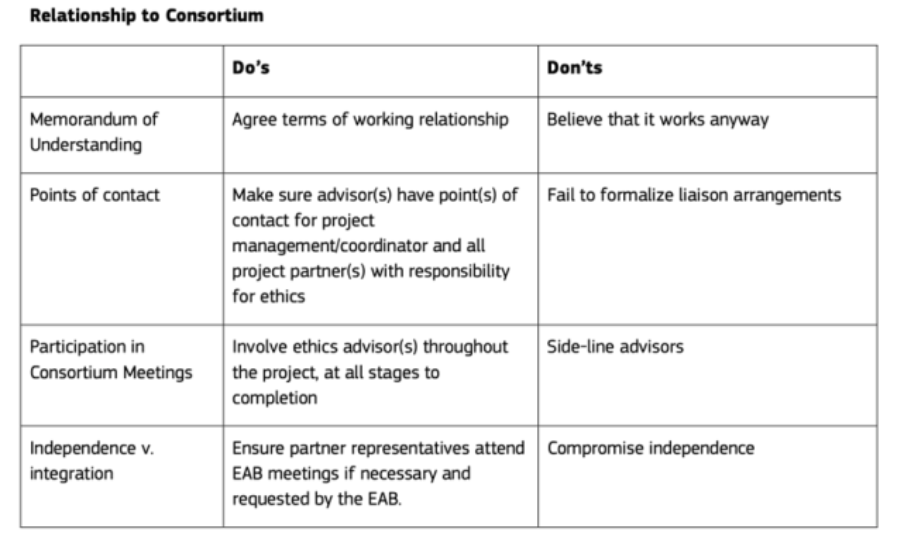
Ethics Advisors and Ethics Advisory Boards. Roles and Function in EU-funded Projects. Version 2.0. p.15. The authors of this section declare that they have the right to share this content on a website.
Key ethical, legal and societal implications #
Independence and integrity #
EAs/EABs must be independent from the core research team to ensure objective oversight. Conflict of interest must be avoided — both in appointments and decision-making processes.
Diversity #
EAs/EABs should have the relevant expertise (e.g., bioethics, data ethics, clinical research). Multidisciplinary composition is ideal. Lack of diversity (gender, cultural, stakeholder) may reduce legitimacy and inclusivity.
Transparency and accountability #
The roles, responsibilities, and procedures of the Ethics Advisor/EAB must be clearly defined. Their work should be documented and traceable (e.g., reports, meeting minutes).
Compliance with legal and ethical frameworks #
Ethics Advisors must ensure the project complies with data protection regulations, human rights, ethical principles. They may be tasked with reviewing Data Protection Impact Assessments, Material/Data Transfer Agreements, and informed consent processes.
Public trust #
Ethics oversight mechanisms contribute to the credibility and trustworthiness of research. A poorly functioning EA/EAB can undermine legitimacy. Ethics Advisors should engage with societal values and promote anticipatory governance and stakeholder engagement (e.g., patient groups, civil society).
Promoting responsible research and innovation (RRI) #
The presence of an Ethics Advisor/EAB aligns with Horizon Europe’s RRI objectives:
- Anticipation
- Reflexivity
- Inclusiveness
- Responsiveness


