
Overview #
Making data available to others is a way for encouraging connection and collaboration between researchers, which can result in relevant new scientific findings. Thus, data sharing allows researchers to share information and resources with other scholars.
Such sharing can occur at the local or national level or within the EU or, more broadly, at the international level, i.e., beyond the European borders if taking the European perspective.
International data-sharing needs a solid data protection law framework. In Europe the legal framework for allowing international transfers can be found mainly in the General Data Protection Regulation (GDPR).
Such transfer may then occur, on the basis of the GDPR, through adequacy decisions or contractual agreements (such as Material Transfer Agreements or Data Transfer Agreements according to their object) or other contractual clauses.
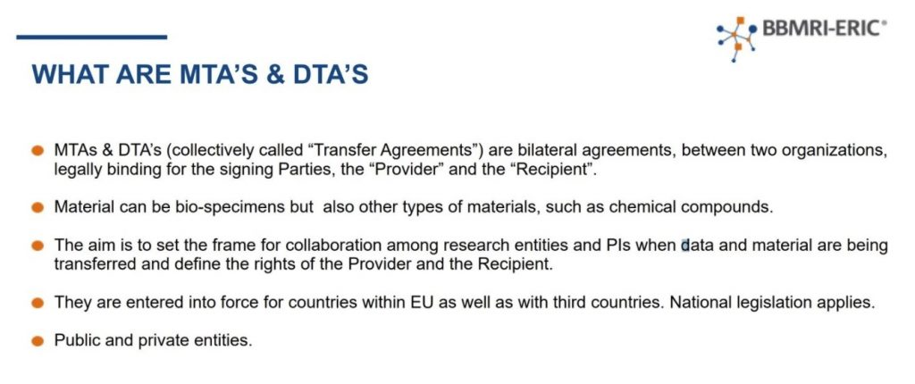
Material Transfer Agreements (MTAs) and Data Transfer Agreements (DTAs) are essential governance instruments that regulate the transfer of biological materials and data between organisations. They provide legal certainty regarding ownership, permitted uses, intellectual property rights, confidentiality, publication, liability, and compliance with applicable legislation. Beyond their contractual function, MTAs and DTAs are important tools for promoting ethical, transparent, and responsible collaboration in biomedical research.
Key ethical, legal and societal implications #
Respect for participants’ consent and expectations #
The transfer of biological materials or personal data should remain consistent with the informed consent provided by participants and with the purposes for which samples or data were originally collected. Secondary use should respect participants’ reasonable expectations and applicable ethical approvals. Where broad consent has been obtained, governance mechanisms should ensure that future uses remain compatible with the original consent and relevant legal requirements.
Data protection and privacy #
DTAs play a crucial role in ensuring compliance with data protection legislation, particularly when personal or genetic data are transferred across institutions or national borders. Agreements should clearly define the roles and responsibilities of the transferring and receiving parties, specify appropriate technical and organisational security measures, and establish conditions for access, storage, retention, and deletion of data. Particular attention is required when transferring special categories of personal data, including genetic and health data.
International transfers and regulatory compliance #
International sharing of biological materials and associated data enables scientific collaboration but may expose participants and institutions to legal and ethical risks if governance standards differ across jurisdictions. Transfers outside the European Economic Area require compliance with Chapter V of the General Data Protection Regulation (GDPR), including adequacy decisions, Standard Contractual Clauses (SCCs), or other appropriate safeguards. MTAs and DTAs should therefore ensure that equivalent levels of protection are maintained regardless of the recipient country.
Intellectual property and fair benefit sharing #
Research collaborations frequently generate new scientific knowledge, technologies, and potentially valuable intellectual property. MTAs and DTAs should clearly define ownership of transferred materials or data, conditions for commercialisation, publication rights, and access to research results. Fair and transparent agreements contribute to equitable benefit sharing among collaborating institutions while recognising the contributions of participants whose samples and data enable research.
Transparency, accountability, and trust #
Public trust in biobanking and biomedical research depends upon transparent governance of data and material sharing. Clearly defined MTAs and DTAs help demonstrate accountability by documenting the purposes of transfer, permitted uses, security obligations, and responsibilities of each party. Such transparency supports responsible research practices and strengthens confidence among research participants, institutions, and society.
Interoperability and responsible data sharing #
As biomedical research increasingly relies on multinational collaborations, digital biobanks, and federated research infrastructures, MTAs and DTAs facilitate responsible data sharing while supporting interoperability. Standardised contractual frameworks reduce administrative burdens, promote harmonisation across institutions, and contribute to the implementation of the FAIR (Findable, Accessible, Interoperable, Reusable) principles, provided that legal and ethical safeguards are maintained.
Legal and ethical international and EU sources #
- Rules on international data transfers, European Commission
- The General Data Protection Regulation (GDPR)
- The Data Protection Law Enforcement Directive
- National data protection authorities: EU countries have set up national bodies responsible for protecting personal data in accordance with Article 8(3) of the Charter of Fundamental Rights of the EU.
BBMRI-ERIC resources #
Webinars #
Material and Data Transfer Agreements are crucial contractual documents in health research projects when transferring samples or data. However, when is an MTA/ DTA really necessary and what should be included? Who has authority to sign these Agreements? This webinar provides answers to these common questions.
- Material and Data Transfer Agreements
- Pt. 1 What are MTAs and DTAs?
- Pt. 2 Who needs MTAs and DTAs and Why Are They Needed
- Pt. 3 Negotiation and Execution of MTAs and DTAs
- Pt. 4.1 Key Information Included in MTAs and DTAs
- Pt. 4.2 Key Information Included in MTAs and DTAs
- Pt. 5 The Importance of MTAs and DTAs
- Pt. 6 An Example of an Existing MTA and DTA Template
Templates #
Any use of these sample templates is the exclusive responsibility of the respective users.
- Sample Material Transfer Agreement
- Sample Data and Material Transfer Agreement
- Data Transfer Guide for African States/EU Member States
- Sample Data Transfer Agreement – Outgoing for Data Transfer within the EU
- Data Transfer Agreement
External resources #
- Life Science RI, European Life Science Research Infrastructures: templates for Collaboration Agreements, Confidentiality Agreements, and MTA/DTAs
- OECD: MTA https://www.oecd.org/content/dam/oecd/en/topics/policy-sub-issues/testing-of-chemicals/test-guidelines-documents/example_tg_material_transfer_agreement_(mta)_template.pdf
- Austrian national contact point for Intellectual Assets and Knowledge Valorisation: MTA https://www.ncp-ip.at/en/vertragsmuster-ipag/sample-contracts/material-transfer-agreements
- Berlin Institute of Health https://www.bihealth.org/de/plattformen-programme/charite-bih-innovation/material-transfer-agreement-mta
Relevant literature #
- Kaye J, Heeney C, Hawkins N, de Vries J, Boddington P. Data sharing in genomics–re-shaping scientific practice. Nat Rev Genet. 2009 May;10(5):331-5. doi: 10.1038/nrg2573. PMID: 19308065; PMCID: PMC2672783.
- Shabani M, Borry P. Rules for processing genetic data for research purposes in view of the new EU General Data Protection Regulation. Eur J Hum Genet. 2018 Feb;26(2):149-156. doi: 10.1038/s41431-017-0045-7. Epub 2017 Nov 29. PMID: 29187736; PMCID: PMC5838983.


