
Overview #
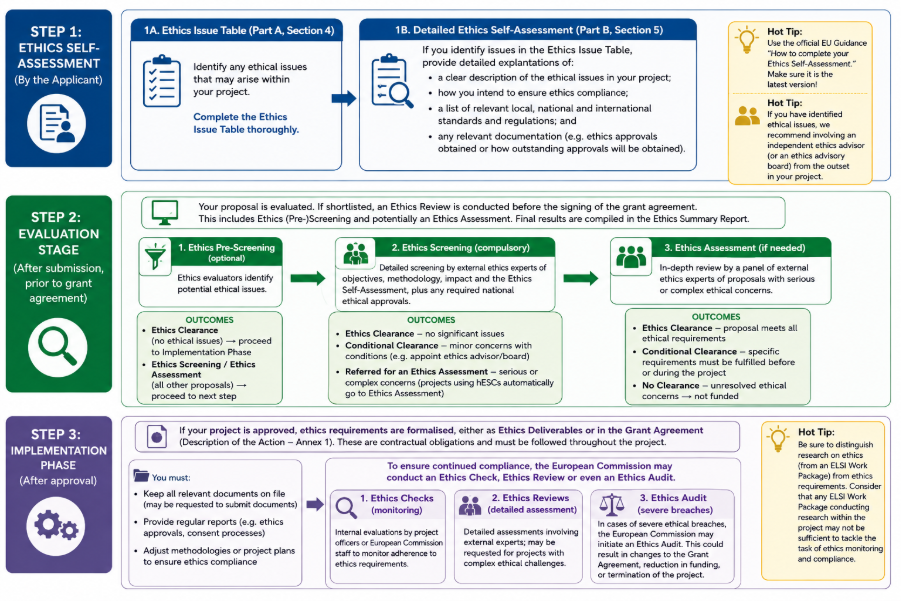
The Ethics Appraisal is a crucial step in securing funding for your research. It ensures that your project complies with ethical principles and EU standards. BBMRI-ERIC recommends that you familiarise yourselves with the EU Ethics Appraisal procedure and gain understanding of the steps involved. To assist you, here is a guide to navigate the process.
Steps #
Step 1: Ethics Self-Assessment #
As an Applicant, you must complete the Ethics Self-Assessment consisting of two steps: the Ethics Issue Table and a detailed Ethics Self-Assessment (Parts A & B of the proposal). In these sections, it is imperative that you demonstrate both awareness of relevant ethical issues arising in your project, as well as how these issues will be addressed.
Hot Tip: Use the official EU Guidance “How to complete your Ethics Self-Assessment.” Make sure it is the latest version!
The Ethics Issue Table (Part A, Section 4)
The Ethics Issue Table is located online in the administrative proposal forms. It requires you to identify any ethical issues that may arise within your project. Be sure to complete the Ethics Issue Table thoroughly.
Detailed Ethics Self-Assessment (Paty B, Section 5)
If you identify issues in the Ethics Issue Table, you must provide detailed explanations in Part B, Section 5. In this section, describe how you intend to address the ethical issues in your project. Be sure to include:
- a clear description of the ethical issues in your project;
- a thorough explanation of how you intend to ensure ethics compliance;
- a list of relevant local, national and international standards and regulations; and
- any relevant documentation, such as ethics approvals that have been obtained or how you will go about obtaining any outstanding ethical approvals.
Hot Tip: If you have identified ethical issues, we recommend involving an independent ethics advisor (or an ethics advisory board) from the outset in your project
Step 2: Evaluation stage #
After submission, your proposal enters the evaluation stage. If your proposal is shortlisted, an Ethics Review is conducted. This consists of an Ethics (Pre-)Screening process and potentially an Ethics Assessment, and occurs prior to the signing of the final grant agreement. The final results are compiled in the Ethics Summary Report, which is sent to applicants.
Ethics Pre-Screening
This is an optional preliminary step where ethics evaluators identify potential ethical issues. Outcomes include:
- Ethics Clearance – Proposals that raise no ethical issues can proceed to the next stage, namely the Implementation Phase of the proposal.
- Ethics Screening / Ethics Assessment – All other proposals are referred to a compulsory Ethics Screening or an Ethics Assessment.
Ethics Screening
All proposals undergo a detailed screening conducted by external ethics experts, consisting of an evaluation of the proposal’s objectives, methodology, and impact. Particular attention is paid to the Ethics Self-Assessment you completed, along with any proposals requiring ethical approval at national level. Outcomes include:
- Ethics Clearance – If no significant issues are found, your proposal receives an Ethics Clearance.
- Conditional Clearance – If minor ethical concerns are flagged, there may be certain conditions attached that must be fulfilled. For example, you may be required to appoint an independent ethics advisor or board.
- Referred for an Ethics Assessment – Proposals flagged with serious or complex ethical concerns are referred for an Ethics Assessment. Any projects involving the use of Human Embryonic Stems Cells (hESCs) will automatically undergo an Ethics Assessment
Ethics Assessment
An Ethics Assessment will only be conducted where it has been recommended, namely if your proposal involves serious or complex ethical concerns. An in-depth review is conducted by a panel of external ethics experts. Outcomes of the Ethics Assessment:
- Ethics Clearance: Your proposal meets all ethical requirements and can proceed.
- Conditional Clearance: Specific requirements must be fulfilled before or during the project.
- No Clearance: Proposals with unresolved ethical concerns will not be funded.
Step 3: Implementation Phase #
If your research project is approved, ethics requirements are formalised, either as Ethics Deliverables or as part of the Grant Agreement in the project’s Description of the Action (Annex 1). These are contractual obligations and must be followed throughout the project.
You should keep all relevant documents on file and may be requested to submit individual documents. You may be required to:
- Provide regular reports, such as documentation of ethics approvals or consent processes;
- Adjust methodologies or project plans to ensure ethics compliance.
To ensure continued compliance, the European Commission may conduct an Ethics Check, Ethics Review or even an Ethics Audit during the project’s lifespan.
Ethics Checks – Ethics Checks involve the monitoring of ethics issues. These internal evaluations are conducted by project officers or the European Commission staff to monitor your adherence to ethics requirements.
Ethics Reviews – These reviews are more detailed assessments involving external experts and may be requested by the European Commission for projects with complex ethical challenges.
Ethics Audit – In cases of severe ethical breaches, the European Commission may initiate an Ethics Audit. This could result in changes to the Grant Agreement, a reduction in funding, or even the termination of the project.
Hot Tip: Be sure to distinguish research on ethics from ethics requirements. Consider that any ELSI Work Package conducting research within the project may not be sufficient to tackle the task of ethics monitoring and compliance.

What are serious or complex ethical issues? #
Projects are flagged as having serious or complex ethical concerns if they:
- Risk violating fundamental rights or EU values.
- Pose significant harm to researchers, participants, the public, animals, or the environment.
- Involve contentious research areas
- Lack adequate ethics frameworks in the relevant country where research is conducted.
Note: Projects involving the use of Human Embryonic Stem Cells (hESCs) are automatically considered as serious, and will always be subject to an Ethics Assessment.
Best practises for applicants #
To maximise your chances of a successful ethics appraisal process, we recommend that you:
- Anticipate and proactively address ethical challenges from the outset
- Consult independent ethics advisors for guidance.
- Include an ethics advisor / ethic advisory board in your project
- Maintain thorough and transparent documentation for all ethics-related aspects of your project.
Relevant EU sources #
Contact #
If you have any further questions, feel free to contact our Helpdesk.


